 PluginStats
babel-plugin-angularjs-annotate weekly downloads statistics
By schmod · npm · Babel plugins
Babel plugin to add angularjs dependency injection annotations
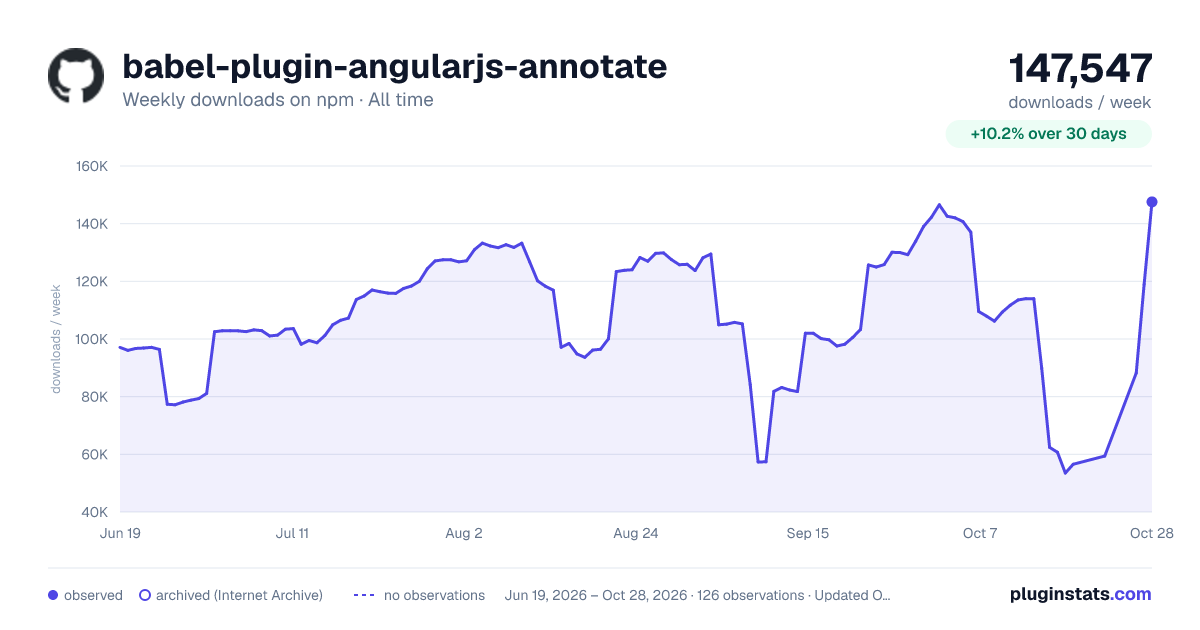
babel-plugin-angularjs-annotate has 53,519 recorded weekly downloads on npm, a decrease of 46.3% over the past 30 days.
It ranks #543 of 2,256 tracked npm listings by weekly downloads.
Over 90 days, weekly downloads changed by -52.9%.
PluginStats has 121 daily observations since Jun 19, 2026; the latest is from Oct 17, 2026.
About babel-plugin-angularjs-annotate
babel-plugin-angularjs-annotate
Fork of ng-annotate for Babel users, with a focus on speed and ES6 support.
Adds Angular 1.x DI annotations to ES5/ES6 code being processed by Babel, with support for explicit annotations (/* @ngInject */), and automatic (implicit) annotation of typical Angular code patterns.
Fully compatible with ES5, transpiled ES6, and raw ES6 sources. Offers significantly reduced build times for projects already using Babel, compared to the standalone ng-annotate tool.
This plugin currently supports matching and transforming all of the patterns currently recognized by ng-annotate (explicit and implicit), and passes the relevant portions of ng-annotate's test suite.
Installation
Use like any other Babel plugin.
Most users will want to run
and add the plugin to your .babelrc file:
Options
explicitOnly
By default, this plugin will attempt to add annotations to common AngularJS code patterns. This behavior can be disabled (requiring you to mark up functions with /* @ngInject */ or 'ngInject').
To pass this option to the plugin, add it to your Babel configuration:
Usage
See ng-annotate's documentation and the test sources for details about the patterns that can be automatically detected by ng-annotate and this plugin, as well as information about how to explicitly mark functions and classes for annotation.
Try it out in your browser.
ES6 Annotations
This plugin can annotate some ES6 classes and arrow functions that are not supported by ng-annotate:
Implicit arrow function annotation
Arrow functions may be annotated anywhere that a "regular" function expression may be used.
NOTE: There are places where you _shouldn't_ use arrow functions in an Angular application. Inside of an arrow function, the value of this is inherited from the lexical scope enclosing the function. For this reason, arrow functions should not be used to declare Angular services or providers.
_If you choose to ignore this warning, we'll add the annotations to your services and providers anyway, but your application probably won't work. Future releases may treat this condition as an error._
Becomes:
Explicit arrow function annotation
Arrow functions may also be explicitly marked for annotation.
Becomes:
Implicit Class Annotation
If a class is declared as an Angular service or factory in the same file as it is declared, it will be annotated automatically:
Becomes:
Explicit Class Annotation
If a class is exported and used in another file/module, it must be explicitly marked for injection:
Prologue directives may also be used here:
Object Method Shorthand
Object methods can be written with the new shorthand syntax:
Exports
Exported functions and classes may be annotated. Exported functions must have names:
Notes & Philosophy
This project/experiment does _not_ seek to replace ng-annotate. However, it does seek to provide similar functionality for Angular 1.x developers who are already using Babel and/or writing code in ES6.
Because of some of the limitations presented by Babel's transformation process, this project does not aim to achieve feature parity, or provide identical output to ng-annotate. Notably, Babel does not preserve formatting and indentations like ng-annotate does, and this project does not seek to replicate the features of ng-annotate that remove or transform existing annotations.
Initially, I had hoped to make very few modifications to the upstream sources, in the hopes of eventually merging babel support directly into ng-annotate. Unfortunately, Babylon appears to have diverged too far from Acorn to make that goal realistic. (I would love to be wrong here, and would welcome contributions that close the gap between the two projects!)
To run tests:
License
MIT, see LICENSE file.
This project is a fork of ng-annotate, which was written by Olov Lassus with the kind help by contributors. Follow @olov on Twitter for updates about ng-annotate.
Description from the npm listing.
- angular
- angularjs
- di
- dependency
- injection
- annotate
- annotation
- annotations
- transformation
- babel-plugin
Where babel-plugin-angularjs-annotate sits in the listing
Each band is one page of 20. Weekly downloads on a log scale. Placement is projected from weekly downloads, so it can differ from the marketplace's own sort order. Hover a dot to see the listing.


Charts
Images: 30d · 1y · all time · 1600×900 dark



Adoption over time


7/30/90-day growth


Filled points are observed values; hollow points come from Internet Archive snapshots of the listing page. Dashed segments span periods with no observations — values between points are not interpolated.
Recent observations
Full history (121)Similar npm Babel plugins plugins
Data source
Weekly downloads (trailing 7 complete days) come from the official npm downloads API. Downloads include CI and mirrors and are not equivalent to installs or users. npm publishes no ratings.
Listing: https://www.npmjs.com/package/babel-plugin-angularjs-annotate. First seen Oct 16, 2026; last successful collection Oct 19, 2026. See the methodology.