 PluginStats
@opum-ai/quest weekly downloads statistics
By opum-ai (2 listings) · npm · Claude Code
Deterministic, LLM-free task tracker CLI — the record layer coding agents and humans write to.
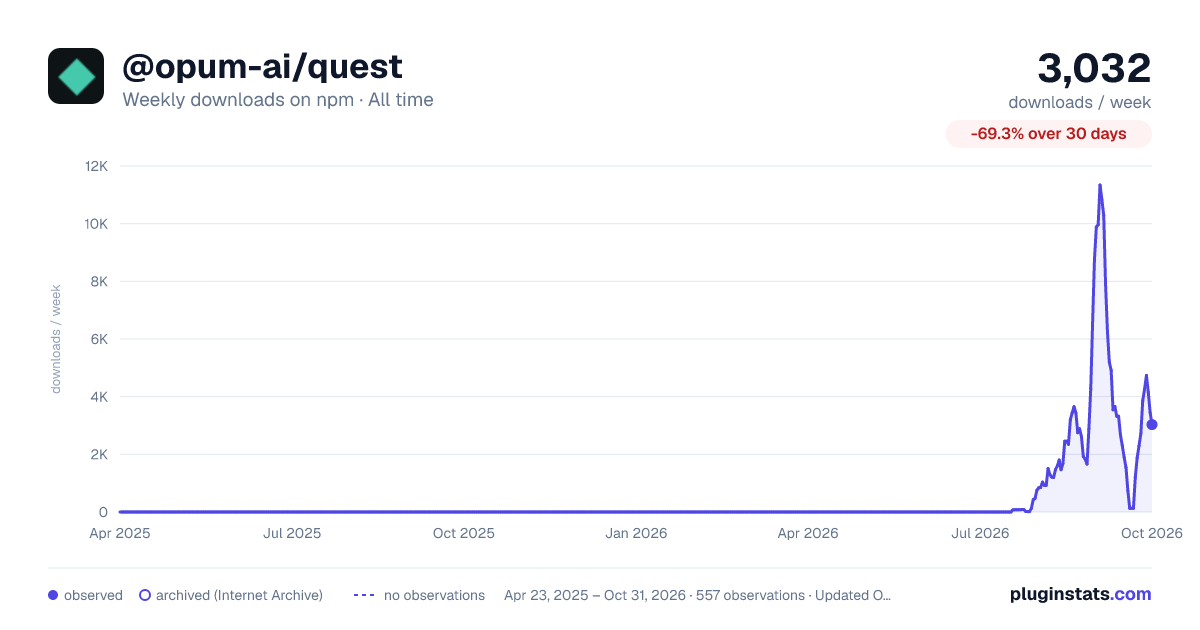
@opum-ai/quest has 739 recorded weekly downloads on npm, a decrease of 78.5% over the past 30 days, ranking #1486 of 2,322 tracked listings.
About @opum-ai/quest
quest
A deterministic, LLM-free task tracker CLI — the record layer coding agents and humans write to, and that tools like
lorecouple to over JSON.
quest is the tracker of record for repository-resident work: tasks, drafts,
decisions, and milestones live as plain JSON under .quest/, committed to Git
alongside the code they describe. There is no server, no database, and no LLM
in quest's core — every command is deterministic, reproducible, and
CI/agent-safe (non-interactive by default, stable semantic exit codes,
machine-readable --json).
- Built on Bun + TypeScript with an exact-pinned Commander parser; a
versioned capability manifest (
quest manifest --json) is the live, authoritative description of the command surface. - Published on npm as
@opum-ai/quest(binquest) with six exact-pinned platform packages, including Windows ARM64. - The agent bridge is a generated managed block in
CLAUDE.md,AGENTS.md, orGEMINI.md(Claude Code, Codex/OpenCode/pi/etc., and Google Antigravity/Gemini CLI respectively) plusquest instructionsfor just-in-time, task-shaped guidance.
Status: released. The release tag, the qualified workflow artifacts, all seven public
@opum-ai/quest*npm packages, and a clean registry install agree on one published version. This file deliberately does not restate that number, andbun run check:packagesfails the release if it reappears: a version hand-maintained here goes stale the moment the next release lands, and becauseREADME.mdships inside the tarball, the npm page then advertises the wrong one permanently -- version pages are immutable. npm and the repository's tags both show the current version already. Releases are qualified in lockstep with@opum-ai/lore. Seedocs/reference/quest-cli-release-truth.md.
The headline: every write declares who made it
quest never accepts an anonymous write. Every command that mutates a
record — task create, task edit, task complete, and the rest — requires
an explicit actor declaration:
quest task edit QCLI-1 --status "In Progress" \
  --actor jdnewhouse --actor-kind human
or, when the actor performing the write is an agent rather than the human it answers to:
quest task edit QCLI-1 --status "In Progress" \
  --actor my-agent-session --actor-kind delegated-agent \
  --accountable-human jdnewhouse
A missing --actor-kind is rejected outright ("Tracker writes require an
explicit actor declaration"); an invalid value names itself and lists the
valid kinds. This is deliberate, load-bearing provenance, not an
afterthought — it is what lets a record say not just what changed but who
is accountable for it, which matters most exactly when the actor is an
autonomous agent.
Tools couple to quest the same way quest couples to Git: by reading its
deterministic JSON, never by parsing prose or editing .quest/ files
directly. lore is the reference consumer — see
Lore dependency and adapter contract evidence.
Install
The package and bin are @opum-ai/quest and quest:
# Node / npm
npx @opum-ai/quest --help

# Bun
bunx @opum-ai/quest --help

# Global npm install
npm install -g @opum-ai/quest
The launcher installs only the matching script-free platform package for your OS/architecture, so a current install requires no install-script approval exception. There is no native addon and nothing to compile locally.
Or add it to a project:
bun add -d @opum-ai/quest # or: npm i -D @opum-ai/quest
The npm package is a dual artifact: a tiny Node .cjs launcher plus a
per-platform compiled binary (built with bun build --compile), delivered as
optionalDependencies — macOS, Linux, and Windows, each on x64 and arm64.
Quickstart
Every command is non-interactive by default and emits stable, semantic exit
codes. Output has three modes: pretty (default, color on a TTY), --plain
(ANSI-free stable text), and --json (a {schemaVersion, kind, data}
envelope on stdout, with errors on stderr as {error_type, message, hint}).
The one interactive path is quest init on a bare TTY invocation, which runs
a guided setup (project name, task ID prefix, a multi-select for which
instruction file(s) to write) — any flag or a non-TTY stdin runs it fully
non-interactively instead.
# 1. Initialize a Quest workspace in the current Git worktree.
quest init --name "My Project" --task-id-prefix ABC

# 2. Create a task. Every write needs an actor.
quest task create "Fix the flaky retry loop" \
  --description "Retries don't back off; a burst of failures thundering-herds the API." \
  --acceptance-criteria '["Retry loop applies exponential backoff with jitter"]' \
  --actor jdnewhouse --actor-kind human

# 3. Move it forward.
quest task edit ABC-1 --status "In Progress" --actor jdnewhouse --actor-kind human

# 4. See what's actually ready to work — dependencies resolved, blockers respected.
quest task list --ready --json

# 5. Finish it with evidence, not on faith.
quest task edit ABC-1 --check-ac 1 --actor jdnewhouse --actor-kind human
quest task edit ABC-1 --final-summary "Added exponential backoff with jitter; verified via the retry-storm test." \
  --actor jdnewhouse --actor-kind human
quest task complete ABC-1 --actor jdnewhouse --actor-kind human
--json is the additive-only machine contract:
$ quest task view ABC-1 --json
{
  "schemaVersion": 1,
  "kind": "task.view",
  "data": { "id": "ABC-1", "status": "Done", "title": "Fix the flaky retry loop", "..." : "..." },
  "principal": null
}
```…
Description from the npm listing.
- cli
- task-tracker
- project-management
- issue-tracking
- ai-agents
- claude-code
README badge
Show your rank in a README or on your website. The badge updates automatically.
Charts
Images: 30d · 1y · all time · 1600×900 dark



Adoption over time
7/30/90-day growth
Ranking history
Listing placement
Listing placement
Filled points are observed values; hollow points come from Internet Archive snapshots of the listing page. Dashed segments span periods with no observations — values between points are not interpolated.
Each band is one page of 20. Weekly downloads on a linear scale. Placement is projected from weekly downloads, so it can differ from the marketplace's own sort order. Hover a dot to see the listing.
Recent observations
Full history (544)Similar npm Claude Code plugins
All 20 @opum-ai/quest alternativesData source
Weekly downloads (trailing 7 complete days) come from the official npm downloads API. Downloads include CI and mirrors and are not equivalent to installs or users. npm publishes no ratings.
Listing: https://www.npmjs.com/package/@opum-ai/quest. First seen Oct 16, 2026; last successful collection Oct 20, 2026. See the methodology.