 PluginStats
@tanstack/ai-octane has 81 recorded weekly downloads on npm, a decrease of 74.5% over the past 30 days, ranking #1695 of 2,256 tracked listings.
About @tanstack/ai-octane
@tanstack/ai-octane
TanStack AI bindings for the Octane UI framework.
This package ports the @tanstack/ai-react hook surface onto Octane while reusing @tanstack/ai and @tanstack/ai-client unchanged. The runtime export surface matches the React adapter, so migration starts by changing the package import:
The renderer-bearing hook modules are authored as .tsrx and compiled by Octane. Matching .tsrx.d.ts companions are checked declaration emits of those implementations, preserving the complete generic surface for TypeScript consumers.
Like Svelte packages shipping .svelte, this package publishes uncompiled source: your Octane plugin (octane/compiler/vite, or the rspack / rspeedy equivalents) compiles the .tsrx modules as part of your build. There is no dist.
Install
Usage
useChat has no input state of its own — hold the text box value in a local useState and pass it to sendMessage. Note the onInput handler: Octane drives text controls per keystroke through the native input event, not a synthetic onChange.
API
The adapter includes useChat, useRealtimeChat, useMcpAppBridge, useGeneration, useGenerateImage, useGenerateAudio, useGenerateSpeech, useGenerateVideo, useTranscription, useSummarize, and useAudioRecorder. It also re-exports all 30 @tanstack/ai-client convenience helpers and types (fetchServerSentEvents, fetchHttpStream, xhrServerSentEvents, xhrHttpStream, stream, rpcStream, createChatClientOptions, createMcpAppBridge, and their associated types) unchanged, mirroring the @tanstack/ai-react index.
Server rendering through octane/server is supported. useChat renders its initial message snapshot without browser-only setup.
Divergences from @tanstack/ai-react
• The ./mcp-apps subpath and its MCPAppResource component are not ported: they render AppRenderer from the React-only @mcp-ui/client, which has no Octane equivalent. The framework-agnostic useMcpAppBridge hook is ported and available on the main entry. • Octane uses native events: text/file/recorder inputs drive updates via onInput; there is no synthetic onChange layer. • Octane has no StrictMode double-invoke and always provides useId, so no random-id fallback is needed. • The devtools bridge is tagged framework: 'octane' (upstream sends 'react'), so the devtools identify this binding correctly. • Realtime reconnects and token refreshes use the latest getToken and adapter supplied to the hook; upstream captures the first render's callbacks. • The declared realtime onStatusChange callback is invoked alongside the hook's state update; upstream @tanstack/ai-react currently drops the external callback. • Changing useChat's connection or fetcher updates the active ChatClient in place and preserves conversation state.
Fixed here, still present upstream
Three defects were found during review of the port and fixed rather than mirrored. All are documented in status.json and covered by tests, and each is tracked upstream so the other adapters can catch up.
• useAudioRecorder's transforming overload requires onComplete. Upstream, passing any unrelated option (useAudioRecorder({ onError })) matched the transforming overload, inferred TOnComplete as unknown, and silently collapsed recording and stop() to unknown. (#1001) • useGeneration spreads caller devtools metadata before the hardcoded framework/hookName, so a caller can't misattribute the binding in the devtools. ai-react spreads it after; ai-vue and ai-solid already order it this way. (#1002) • UseGenerationReturn types generate as (input: TInput). Upstream declares UseGenerationReturn and widens generate to (input: Record), so narrow or required input fields go unchecked. This is the one place the public type surface differs in shape from @tanstack/ai-react — the runtime surface is unchanged, so the "change the import" migration still holds. (#1003)
Status
This binding was developed as @octanejs/tanstack-ai in the octanejs/octane repo as a temporary stopgap, and moved here — apart from the rename, the only changes are the three fixes listed above and the test-helper hardening noted in status.json.
Current scope, divergences, and verification state are tracked in status.json. useChat matches the current ChatClient shape (threadId identity, queue, interrupts, attach/detach).
The port runs TanStack AI's React adapter tests against Octane across all eleven hooks, with no skipped, todo, or expected-failure cases (except the untestable auto-resume case noted in status.json). An SSR fixture and the upstream compile-time type tests are also included.
License
MIT — contains source derived from TanStack AI (MIT), adapted for Octane.
Description from the npm listing.
- ai
- ai-sdk
- typescript
- tanstack
- octane
- chat
- streaming
- tool-calling
- structured-outputs
- media-generation
README badge
Show your rank in a README or on your website. The badge updates automatically.
Charts
Images: 30d · 1y · all time · 1600×900 dark


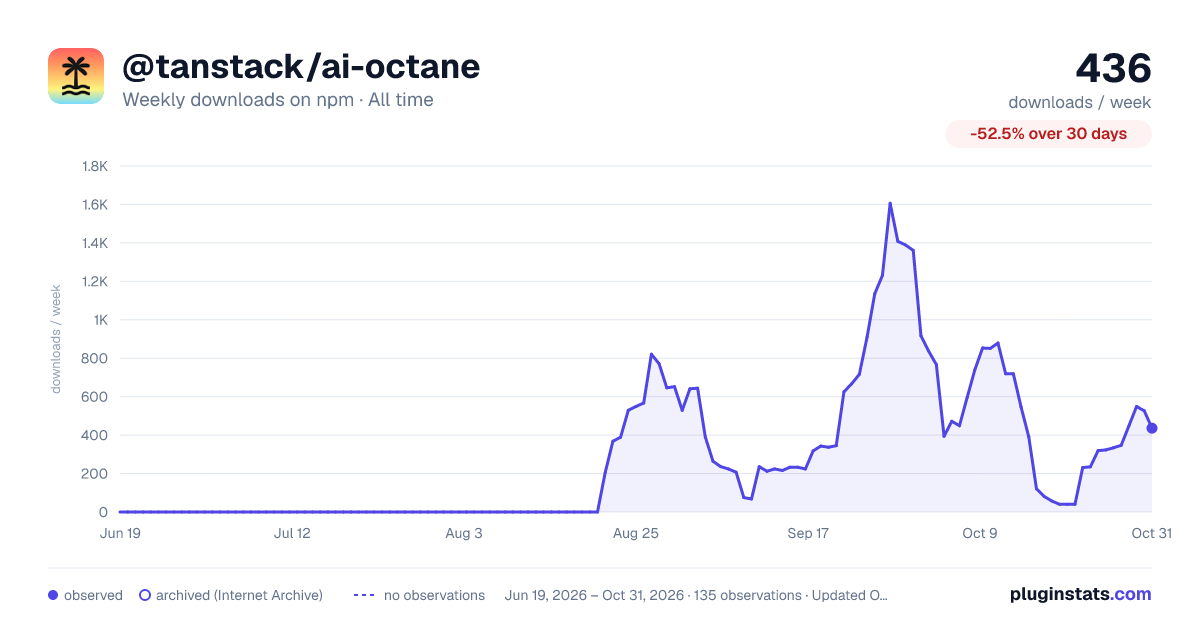

Adoption over time
7/30/90-day growth
Ranking history
Listing placement
Listing placement
Filled points are observed values; hollow points come from Internet Archive snapshots of the listing page. Dashed segments span periods with no observations — values between points are not interpolated.
Each band is one page of 20. Weekly downloads on a linear scale. Placement is projected from weekly downloads, so it can differ from the marketplace's own sort order. Hover a dot to see the listing.
Recent observations
Full history (121)Similar npm AI SDKs plugins
All 20 @tanstack/ai-octane alternativesData source
Weekly downloads (trailing 7 complete days) come from the official npm downloads API. Downloads include CI and mirrors and are not equivalent to installs or users. npm publishes no ratings.
Listing: https://www.npmjs.com/package/@tanstack/ai-octane. First seen Oct 16, 2026; last successful collection Oct 19, 2026. See the methodology.