 PluginStats
mcp-auth weekly downloads statistics
By mcp-auth · npm · MCP servers
Plug and play auth for Model Context Protocol (MCP) servers
mcp-auth has 1,891 recorded weekly downloads on npm, a decrease of 91.1% over the past 30 days.
It ranks #1293 of 2,255 tracked npm listings by weekly downloads.
Over 90 days, weekly downloads changed by -93.1%.
PluginStats has 543 daily observations since Apr 23, 2025; the latest is from Oct 17, 2026.
About mcp-auth
mcp-auth
The MCP SDK asks you to bring two things: a token verifier and your auth metadata. mcp-auth gives you both, for any OAuth / OIDC provider.
Docs & tutorials · Sample servers
The MCP TypeScript SDK v2 (@modelcontextprotocol/server) ships the entire HTTP layer of MCP authorization itself: requireBearerAuth, verifyBearerToken, oauthMetadataResponse, and official framework adapters like @modelcontextprotocol/express. What it leaves to you is provider integration: verifying the access tokens your OAuth 2.0 / OpenID Connect provider issues, and describing that provider in your server's metadata.
That is exactly what mcp-auth does:
1. A token verifier: MCPAuth implements the SDK's OAuthTokenVerifier interface. It discovers your provider's metadata, fetches its JWKS, and verifies JWT access tokens (signature, issuer, audience, expiration, and the claims MCP servers need), with sensible caching throughout. mcpAuth.getBearerAuthOptions() bundles the verifier with the RFC 9728 metadata URL into the SDK's BearerAuthOptions, ready for requireBearerAuth. 2. Your auth metadata: mcpAuth.getAuthMetadataOptions() returns the SDK's AuthMetadataOptions, ready to serve the OAuth discovery documents.
It implements the authorization requirements of the latest MCP specification and works with any OAuth 2.0 / OpenID Connect provider that meets them.
Installation
@modelcontextprotocol/server v2 is a peer dependency. Node.js >= 20; ESM only. Still on MCP SDK v1 (@modelcontextprotocol/sdk)? Use mcp-auth@0.2.
Get started
Head to mcp-auth.dev for tutorials and the full documentation. The sample servers in this repository are complete runnable projects: whoami and todo-manager as Cloudflare Workers, plus an Express variant built with @modelcontextprotocol/express.
Configuration highlights
• protectedResourceMetadata is your RFC 9728 Protected Resource Metadata declaration. Everything in it is published through the SDK's metadata helpers, and the token verifier enforces what it declares: the aud claim must match resource and the iss claim must match the configured authorization server. • authorizationServer accepts a discovery config ({ issuer, type }, metadata fetched lazily and cached, safe for edge runtimes where module-init network calls are not allowed) or a resolved config with metadata (hardcoded or pre-fetched via fetchServerConfig()). • Audience (aud) validation always expects your resource identifier and cannot be redirected or disabled: the MCP authorization specification requires access tokens to be bound to the resource they are issued for (RFC 8707), so tokens without a matching aud claim are rejected. • jwtVerifyOptions passes options through to jose's jwtVerify for advanced tuning (clock tolerance, required claims, etc.); issuer and audience are excluded since they always come from the metadata declaration. • Verified tokens are surfaced as McpAuthInfo, the SDK's AuthInfo plus guaranteed issuer, subject, and the full claims payload.
Opaque access tokens
MCPAuth verifies JWT access tokens against your provider's JWKS. Some authorization servers issue opaque access tokens instead: random strings with nothing to verify locally. The two halves of mcp-auth are decoupled, so this case is covered by bringing your own verifier: implement the SDK's OAuthTokenVerifier against your server's token introspection endpoint (RFC 7662), and keep using the metadata half. The discovery documents, the challenge URL, and getAuthInfo() all work unchanged.
A few things to know:
• The endpoint: some servers advertise it as introspection_endpoint in their metadata, others keep it off the public discovery document entirely (e.g. an internal admin API). Configure whatever yours is. • The credentials: most servers only let authenticated confidential clients introspect tokens issued to other clients; some deployments protect the endpoint at the network level instead. Check your server's policy. • The cost: every request is an introspection round-trip. That is also the point: revoked tokens are rejected immediately. Add caching only if you accept the revocation delay.
Join the discussion
Join the MCP Auth org discussion to ask questions or share your feedback.
Description from the npm listing.
- modelcontextprotocol
- mcp
- oauth
- openid
- connect
- oidc
Where mcp-auth sits in the listing
Each band is one page of 20. Weekly downloads on a log scale. Placement is projected from weekly downloads, so it can differ from the marketplace's own sort order. Hover a dot to see the listing.


Charts
Images: 30d · 1y · all time · 1600×900 dark


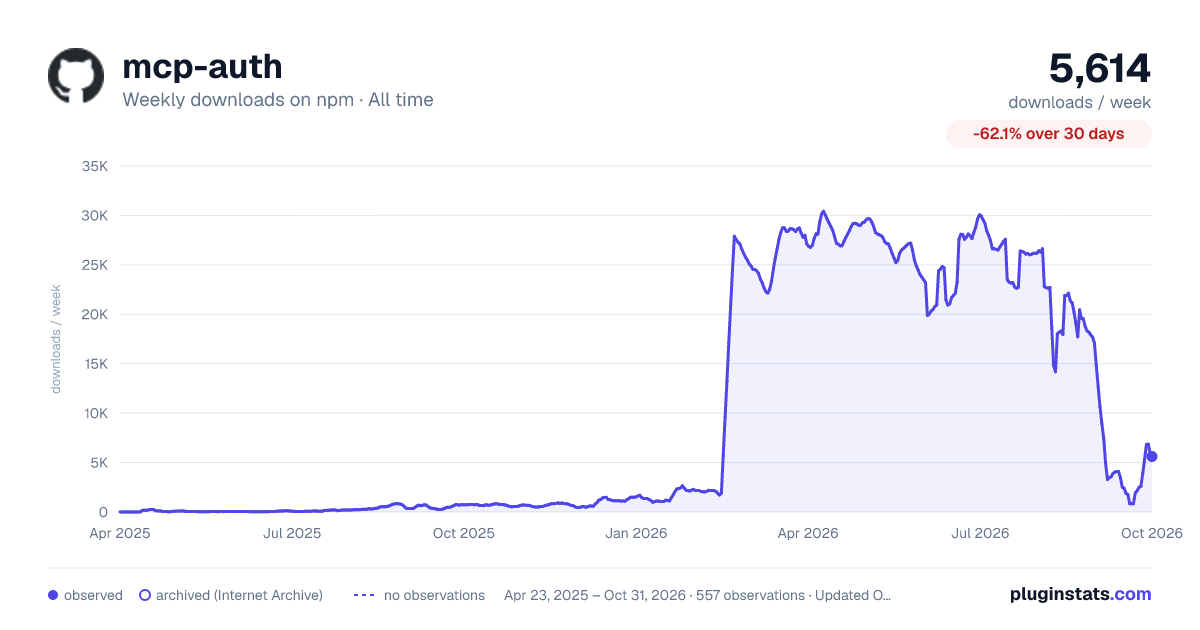

Adoption over time


7/30/90-day growth


Filled points are observed values; hollow points come from Internet Archive snapshots of the listing page. Dashed segments span periods with no observations — values between points are not interpolated.
Recent observations
Full history (543)Similar npm MCP servers plugins
Data source
Weekly downloads (trailing 7 complete days) come from the official npm downloads API. Downloads include CI and mirrors and are not equivalent to installs or users. npm publishes no ratings.
Listing: https://www.npmjs.com/package/mcp-auth. First seen Oct 16, 2026; last successful collection Oct 19, 2026. See the methodology.