 PluginStats
@bill10/agent-007 weekly downloads statistics
By bill10 · npm · Claude Code
From web terminals for your coding agents to a self-running agent company: Claude Code and Codex in parallel git worktrees, a job board they pick work from, and one agent that runs the board from a goal.
@bill10/agent-007 has 392 recorded weekly downloads on npm, a change of -93.3% over the past 7 days, ranking #1586 of 2,322 tracked listings.
About @bill10/agent-007
Agent 007


Manage your coding agents by talking to them, from your phone.
The operations layer for Claude Code and Codex: agents take work from a board, one manager agent reviews and merges what they ship, and you hear about it on a call.
<a href="https://github.com/bill10/agent-007/releases/download/v0.54.1.0/phone-call.mp4"><img src="docs/phone-call-teaser.gif" width="360" alt=""Ask for a change on a call." Then, on a call with Billion in its phone tab, the owner says "Hey Billion, add a dark mode toggle to the settings page""></a>
A Talk to Billion call, from the request to the merged PR: watch the 38s video with sound. Scripted demo with stand-in agents, sped up; voices are text-to-speech (scripts/demo/phone-call.mjs).
- A job board your agents work from. Each card gets its own git worktree, a Claude Code or Codex worker and a real terminal you can type into, and ends as a pull request (or a summary, for work that isn't code).
- One manager agent, Billion. Give it a goal: it posts the cards, reviews the diffs, merges the PRs, and brings you only what needs a person (money, access, security, anything irreversible) in a briefing twice a day.
- Agents that find the right skill. Claude Code fits every installed skill's description into about 1% of its context window; past a hundred or so skills most show as a bare name and get missed. Agent 007 groups them into skill families: its agents see one line per family, and each card lists in full the families its job needs.
- Talk to it from your phone. Open it in your phone's browser over Tailscale (
agent007 install --remote), tap Talk to Billion, and hear progress spoken back. One command installs it as a service; Settings has an Update button, with a What's new window listing the changes first.
The Billion tab

Recorded from the running app, with stand-in agents so the run is repeatable (scripts/demo/record.mjs) -- full 43s video. If the capture does not load, there is a still screenshot.
From web terminals for your coding agents to a self-running agent company. Use it as far along as you need:
-
One task: one agent in a web terminal. Start Claude Code, Codex or any CLI agent in the browser. Add a repo once; every agent gets its own git worktree and branch, so you never set one up by hand.
-
Many tasks across projects: many terminals, one window. Every repo and every agent in one place, with live terminals, a file explorer, inline diffs, and a pixel office where each agent faces its screen while it works and turns to you when it needs you.

-
Stop watching them: a job board. Put tasks on the board and Claude Code or Codex workers pick them up, each in its own worktree, and move them To do -> In progress -> Review on their own, landing as a pull request (or a summary, for work that isn't code). Cards can run Now, be Scheduled for a chosen time, or be Recurring on a cron schedule, and pick their model (strong for hard code, fast for docs), from the models the board finds installed, and agents can post cards and message each other.
-
Stop posting jobs: give Billion a goal. Billion is one always-on agent that plans, posts the jobs, reviews what comes back and merges the PRs. It only asks you about money, access or anything irreversible.
Claude Code, Codex, any terminal agent is supported -- use your existing subscriptions, no extra charge.
It runs locally on your machine, so agents work while it is on and awake. Billion's plan and memory live in a git repo, so it picks up where it left off after a restart. Every worker is a real terminal you can open and type into, from your phone too (remote access).
If you already run your agents this way with Claude Code and a few scripts, great: tell us what you'd do better. If you're tired of being the one who operates them, try this.
Quick Start
To try it:
npx @bill10/agent-007
For daily use, install it and run it as a service, so it starts at login and keeps running after you close the terminal:
npm i -g @bill10/agent-007
agent007 install
Or run agent007 in a terminal (agent-007, the older name, works too). See Run it as a service.
To reach it from your phone or another machine, with Tailscale installed and logged in:
agent007 install --remote # then open https://<this machine>.<tailnet>.ts.net on any device in your tailnet
On a VM behind Cloudflare Tunnel + Access, caddy or nginx instead: agent007 install --public-url https://agent.example.com. See remote access.
Or run it from a clone:…
Description from the npm listing.
- claude-code
- codex
- coding-agents
- ai-agents
- agent-orchestration
- autonomous-agents
- parallel-agents
- git-worktree
- job-board
- kanban
- pixel-art
- terminal
- self-hosted
- mcp
README badge
Show your rank in a README or on your website. The badge updates automatically.
Charts
Images: 30d · 1y · all time · 1600×900 dark


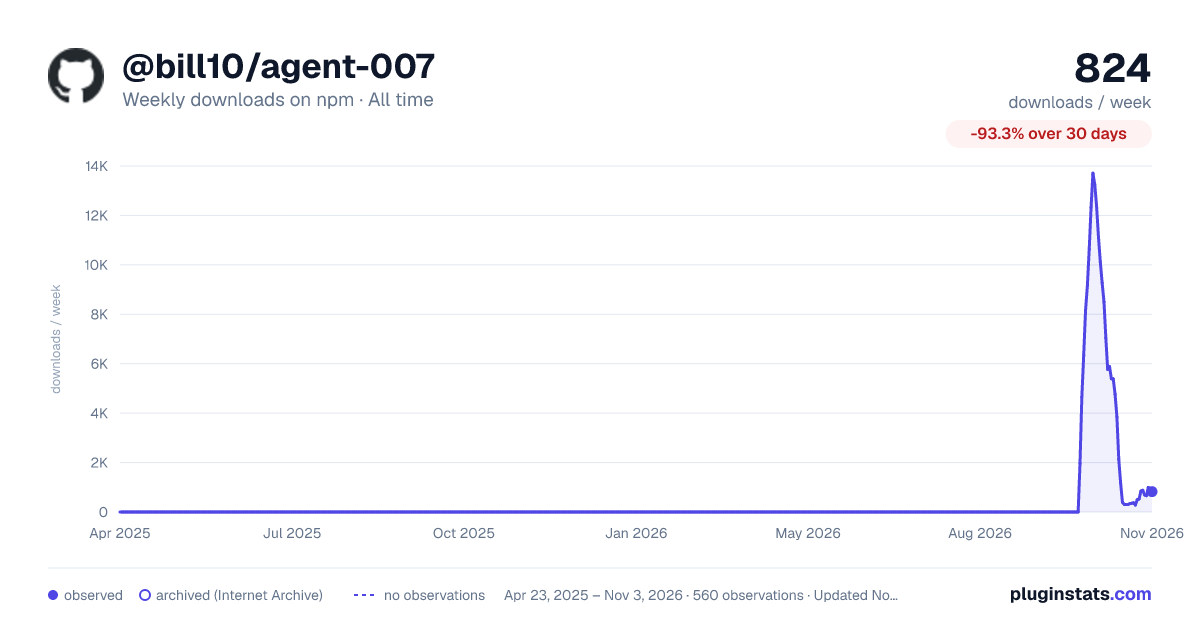

Adoption over time
7/30/90-day growth
Ranking history
Listing placement
Listing placement
Filled points are observed values; hollow points come from Internet Archive snapshots of the listing page. Dashed segments span periods with no observations — values between points are not interpolated.
Each band is one page of 20. Weekly downloads on a linear scale. Placement is projected from weekly downloads, so it can differ from the marketplace's own sort order. Hover a dot to see the listing.
Recent observations
Full history (544)Similar npm Claude Code plugins
All 20 @bill10/agent-007 alternativesData source
Weekly downloads (trailing 7 complete days) come from the official npm downloads API. Downloads include CI and mirrors and are not equivalent to installs or users. npm publishes no ratings.
Listing: https://www.npmjs.com/package/@bill10/agent-007. First seen Oct 16, 2026; last successful collection Oct 20, 2026. See the methodology.