 PluginStats
@kontourai/ferry weekly downloads statistics
By kontourai (4 listings) · npm · Claude Code
Migrate AI conversations between tools — importers and exporters for @kontourai/thread
@kontourai/ferry has 7,335 recorded weekly downloads on npm, an increase of 190% over the past 30 days, ranking #998 of 2,256 tracked listings.
About @kontourai/ferry
@kontourai/ferry
Migrate AI conversations between tools. Importers and exporters for @kontourai/thread, plus the ferry CLI.
Input formats: claude-code, codex, opencode (opencode export JSON), kiro, pi, muse (Muse Code muse export JSON), chatgpt-export, thread. Output formats: thread, openai-chat, anthropic-messages, gemini, markdown.
Importers are grounded in real transcript shapes (including multi-hundred-MB JSONL files, which stream); each adapter documents what its target format cannot represent.
ferry rows emits one JSON object per tool call (or --csv for a narrower projection), streamed per file so it can be pointed at a whole sessions directory. Each row carries the dimensions the schema keeps in different places — source/sourceVersion/cwd/gitBranch from the thread, model/provider from the owning assistant message, the tool's name and raw arguments, parsedArguments when the source supplied structure, derived for importer heuristics, and isError/toolResultId/resultStatus/resultChars joined from the matching ToolResult by toolCallId. Result columns are ABSENT for an unpaired call: a missing result is not a successful one, and resultChars counts result TEXT only, so a result carrying just an image reads as 0. An observed result with unknown standing leaves isError absent rather than being fabricated as false; its resultStatus remains unknown.
Unlike convert/usage, a bad input is warned about and skipped rather than aborting the run: exit 0 means every input was read, 2 means the run completed with inputs skipped, and 1 stays reserved for a fatal error. A file that simply contains no conversation (a sessions directory holds non-transcript sidecars) is reported but is not a skip — it is a normal outcome, not a failure.
There is no sidechain column: in current Claude Code versions subagent traffic lives in separate transcript files rather than inline sidechain lines, so such a column would be permanently false. It returns when an importer reads those files.
--csv cells are emitted verbatim, including a leading =, +, - or @, which a spreadsheet may interpret as a formula. That is deliberate — escaping would corrupt every legitimate -1 and every command starting with a flag — so prefer --jsonl into a query engine for untrusted data.
claude-code-duplicate-toolcall.jsonl is composed: it reproduces the real writer behaviour of emitting one assistant line twice (same uuid, same message.id), which the importer merges by message.id — observed once across 72,735 rows of a local corpus.
Codex fixture provenance: codex-forked-rollout.jsonl (lines 1-4 = rollout 2026-06-25T23-06-53-019f0252 lines 19-22) and codex-rollout-variants.jsonl (lines 1-4 = rollout 2026-03-27T22-21-41-019d32ad lines 8, 10, 11, 15) are byte-copied from real local rollouts — only free-text values are replaced with [redacted]; keys, nesting, and every non-text value remain as written by Codex. codex-rollout.jsonl is a composed fixture whose individual usage records mirror observed shapes. codex-exec-program.jsonl is composed, with each exec payload shaped after the dominant real form measured across a 12.2 GB local corpus: a single double-quoted cmd string (255,070 occurrences) rather than an array (6 occurrences, none of them JSON-parseable — which is why array literals are deliberately not recovered), plus the single-quoted and backtick variants (1,009 / 3,472) and two apply_patch payloads, one of which contains tools.map( in its diffed source because that shape defeated an earlier gate.
Tool-result identity is deterministic and namespaced (ferry::sha256:…), computed only from source record anchors and a source result index. It never uses a call id, output text, timestamp, or prose-derived result status. Claude Code, Codex, OpenCode, Kiro, Pi, and Muse imports capture the observed identity/status surface documented in their adapter headers; ChatGPT exports contain no byte-real tool-result mapping in the retained fixture and remain intentionally unmapped.
The retained Claude Code, OpenCode, Kiro, and Pi fixtures prove their listed success forms but do not contain a byte-real failed tool result. Their error markers therefore remain unknown rather than being promoted from composed examples; adding an error mapping requires an observed writer record and its fixture provenance.
License: Apache-2.0
Description from the npm listing.
- ai
- conversation
- migration
- import
- export
- claude-code
- codex
- opencode
- chatgpt
README badge
Show your rank in a README or on your website. The badge updates automatically.
Charts
Images: 30d · 1y · all time · 1600×900 dark


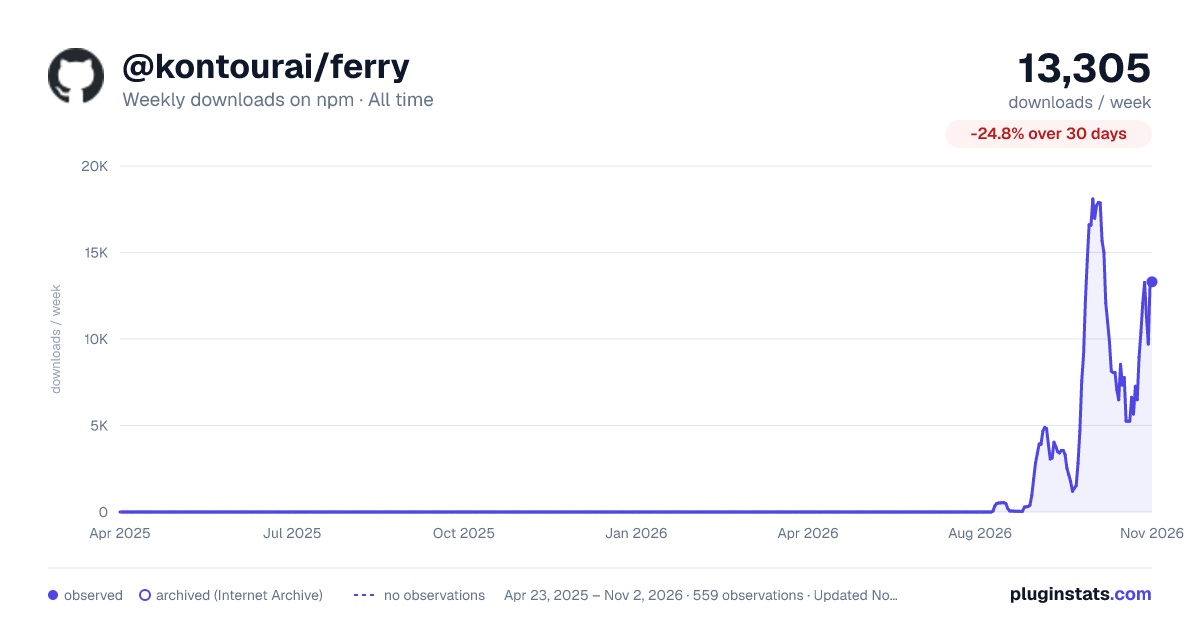

Adoption over time
7/30/90-day growth
Ranking history
Listing placement
Listing placement
Filled points are observed values; hollow points come from Internet Archive snapshots of the listing page. Dashed segments span periods with no observations — values between points are not interpolated.
Each band is one page of 20. Weekly downloads on a linear scale. Placement is projected from weekly downloads, so it can differ from the marketplace's own sort order. Hover a dot to see the listing.
Recent observations
Full history (543)Similar npm Claude Code plugins
All 20 @kontourai/ferry alternativesData source
Weekly downloads (trailing 7 complete days) come from the official npm downloads API. Downloads include CI and mirrors and are not equivalent to installs or users. npm publishes no ratings.
Listing: https://www.npmjs.com/package/@kontourai/ferry. First seen Oct 16, 2026; last successful collection Oct 19, 2026. See the methodology.