 PluginStats
roast-my-design-system weekly downloads statistics
By gregkozakiewicz · npm · Claude Code
Your AI can write the UI. This makes sure it writes your UI. A deterministic scanner scores your design system 0-100 against 119 public repos, reads React and web components (Stencil, Lit), hands you a copy-paste fix prompt for each top finding, writes ru
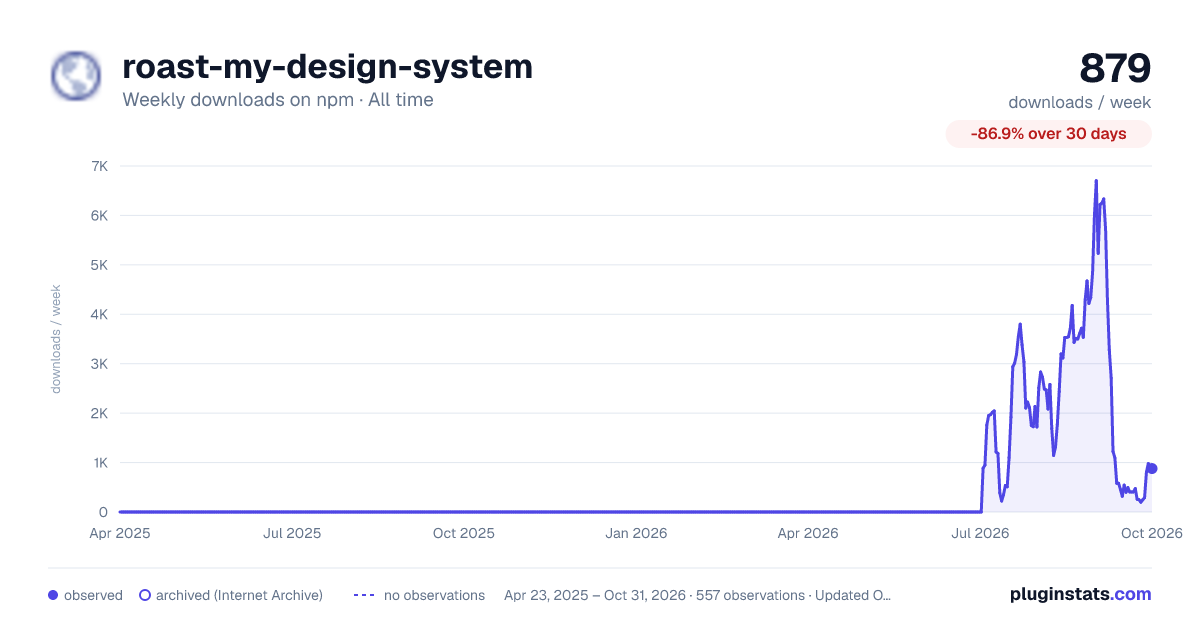
roast-my-design-system has 399 recorded weekly downloads on npm, a decrease of 89.3% over the past 30 days, ranking #1520 of 2,256 tracked listings.
About roast-my-design-system
roast-my-design-system
Find where your AI agent will invent UI.
Your AI can write the UI. This makes sure it writes your UI.
Run it at the root of a UI repo. One second later, a report opens. No account. No network. No telemetry. Nothing in your repo changes.
Version history is in CHANGELOG.md.
The idea
An agent copies what it finds.
It invents where the repo has no answer.
We tested this on 10 real open-source products, in 355 agent sessions, with and without this tool.
Findings each session added, counted by this tool's own rules:
| Task | Model | When | Without roast | Roast MCP and rules installed | Roast plugin with its edit hook |
| A new chart and a new component, 4 products, 3 runs each | Sonnet 5 | Oct 2026, roast 10.1 | 21 in 24 runs | not run | 7 in 24 runs | | A new chart and a new component, 4 products, 3 runs each | Haiku 4.5 | Oct 2026, roast 10.1 | 72 in 24 runs | not run | 1 in 24 runs | | Add a panel, build a dashboard, tighten a list (80 sessions) | Sonnet 5 | Sept 2026 | 7 | 9 | not run | | A Christmas theme, 10 products | Sonnet 5 | Sept 2026 | 28 | 2 | not run | | A new chart, 4 products, 5 runs each | Sonnet 5 | Sept 2026 | 10 in 20 runs | not run | 0 in 20 runs | | A new chart, 4 products | Haiku 4.5 | Sept 2026 | 25 | 39 | 0 in 14 of 15 runs | | Chart, status colour, empty state, new component | Haiku 4.5 | Sept 2026 | 42 in 16 runs | 49 in 16 runs | 3 in 51 runs |
Routine work stayed on-system with or without the tool. Work that needed something new did not.
An agent does not always call a tool when it should. In October, Sonnet called the MCP tools in 7 of 24 sessions and Haiku in 2 of 24. The edit hook runs without being asked. That is the column with the lowest numbers.
Where did the agent invent? Where the repo had nothing to copy. Dub has no chart palette. Its own charts hardcode 17 colours. Asked for a chart, Haiku hardcoded 9 more. In October, 5 of the 7 findings Sonnet left with the plugin on were chart colours on Dub. The agent kept them and wrote a comment saying the repo has no chart palette.
So the mess an agent adds is a map of the gaps in your system.
This tool draws the map.
Roast. Teach. Guard.
Roast the repo to find its real design system, the mess in it, and the gaps.
Teach the agent, through generated rules and a local MCP server.
Guard every edit, so the agent does not have to remember to ask.
ROAST what is in the repo, and what is missing ↓ TEACH rules in the agent files, answers over MCP ↓ GUARD every edit checked, the PR gated
What you get
Where will your agent have to guess?
The first thing the report says: the places where the repo has no answer yet, or "No gaps found".
• the gap, in one line • the files that prove it • the one move that closes it
One gap is known for certain today, because the runs found it: charts hardcoding colours in a repo with no chart palette. 43 of 126 public repos look like that. A gap joins the list when it has been measured.
Fixes you can make right now to increase the health score
The mess the agent will copy, ranked by what fixing it is worth.
• what was found • where, with the file path • why it matters • what to change • a copy button with the fix prompt for your agent
Fix, rescan, press the next button.
A score you can defend in a meeting
0 to 100. The same number every run.
Measured against three yardsticks: the ideal norms of a design system, the median of 34 product repos at the core of a 119-repo benchmark, and 10 reputable systems (Primer, Polaris, Carbon, shadcn/ui and others).
Monorepos get a score per package. packages/ui at 80 stops hiding apps/web at 40.
Every finding, with its file path
• every hardcoded colour, and its near-identical twin • every spacing value off the scale • every duplicated component
And 8 more kinds, all in What it measures. One HTML file. Open it, Slack it, email it.
The colour usage bar shows where the repo's colour comes from: of every 100 colour uses, how many read a theme colour by name, how many use Tailwind's palette, and how many are strays written by hand. It follows CSS variables, Tailwind themes, Sass and Less variables and JavaScript theme objects to do the counting.
The header names what the repo is built on: shadcn/ui, a Tailwind theme, MUI, Mantine, Chakra or Ant Design, and both kits when a repo uses two.
Rules for your agent
Generated from your repo, into design-system-rules.md:
canonical components the token file known duplicates to avoid spacing steps typefaces the kit's own vocabulary
--apply writes them into every agent file you have: Claude, Cursor, GitHub Copilot, Windsurf. Every scan also checks the rules you already have for stale references.
A script does the counting
Every number comes from a deterministic read of your files. Claude writes the explanation, labelled as written by AI and kept apart from the numbers.
How the runs were done
Claude Code, headless, on 10 public products pinned to one commit each: cal.com, Dub, Metabase, Plausible, SigNoz, trigger.dev and four more. 259 sessions in September 2026 and 96 in October 2026 on roast 10.1, with Sonnet 5 and Haiku 4.5. The October sessions repeat the chart and new-component tasks on Plausible, SigNoz, trigger.dev and Dub at the same commits. Every changed file was judged by this tool's rules at the end of the session and at the pinned commit. A finding counts only if the session added it.
Nothing was rendered. Zero findings means the code follows these rules. It does not mean the design was reviewed. Method, tables and limits are in the research write-up, which will be published separately.
Live examples
Eleven reports, hosted exactly as the tool writes them. Every number deterministic, every path real.…
Description from the npm listing.
- design-system
- mcp
- design-tokens
- css
- audit
- lint
- tailwind
- ui
- claude-code
- developer-tools
- mcp-server
- ai-agents
- linter
- code-quality
- cursor
- windsurf
- web-components
- stencil
- lit
- devin
README badge
Show your rank in a README or on your website. The badge updates automatically.
Charts
Images: 30d · 1y · all time · 1600×900 dark



Adoption over time
7/30/90-day growth
Ranking history
Listing placement
Listing placement
Filled points are observed values; hollow points come from Internet Archive snapshots of the listing page. Dashed segments span periods with no observations — values between points are not interpolated.
Each band is one page of 20. Weekly downloads on a linear scale. Placement is projected from weekly downloads, so it can differ from the marketplace's own sort order. Hover a dot to see the listing.
Recent observations
Full history (543)Similar npm Claude Code plugins
All 20 roast-my-design-system alternativesData source
Weekly downloads (trailing 7 complete days) come from the official npm downloads API. Downloads include CI and mirrors and are not equivalent to installs or users. npm publishes no ratings.
Listing: https://www.npmjs.com/package/roast-my-design-system. First seen Oct 16, 2026; last successful collection Oct 19, 2026. See the methodology.