 PluginStats
@mbeato/contextscope weekly downloads statistics
By mbeato · npm · MCP servers
Local dashboard auditing Claude Code's per-turn token context (skills, agents, commands, CLAUDE.md, MEMORY.md, hooks, MCP) with toggle-based disable and session analytics.
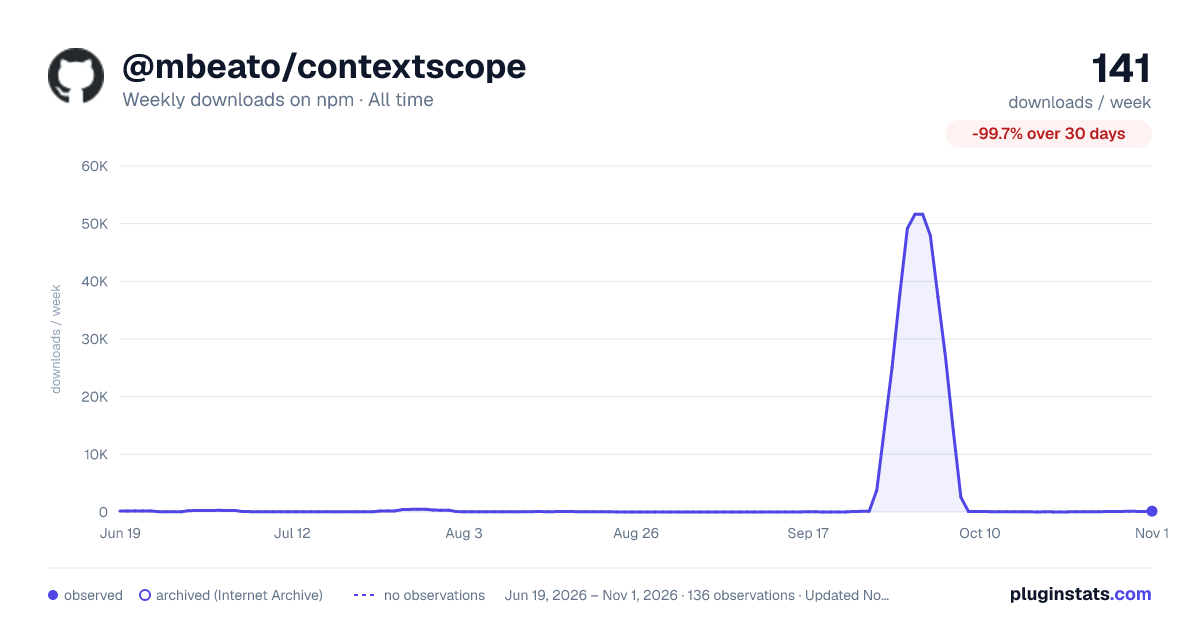
@mbeato/contextscope has 16 recorded weekly downloads on npm, a decrease of 40.7% over the past 30 days.
It ranks #1860 of 2,256 tracked npm listings by weekly downloads.
Over 90 days, weekly downloads changed by -55.6%.
PluginStats has 121 daily observations since Jun 19, 2026; the latest is from Oct 17, 2026.
About @mbeato/contextscope
contextscope
A CLI + local dashboard that audits the per-turn token context Claude Code loads on every conversation turn — and gives you toggle-based control to disable what you don't use.
/stats, /cost, and ccusage show aggregate spend. None of them break down what's *inside* the per-turn baseline or let you act on the audit. At 1M-context Opus, every unused skill, agent, command, or hook output that lives in the available-list block is paying full cache-read cost on every turn — for a heavy user, that's hundreds of millions of tokens per month.
Quick look (CLI)
Prints a 30-day audit to stdout in ~3s. Per-turn baseline, 30-day burn + API-equivalent cost, top disable candidates, context overhead. No browser, no server.
Full dashboard (browser)
Picks a free port starting at 3939, opens your browser. Adds: toggle-to-disable buttons, per-session drilldown, daily burn graph, by-project breakdown, hook + MCP detail.
Or install globally so the contextscope command stays around:
Flags (ui only): • --port — pin a port • --no-open — don't auto-open the browser • --help — full usage
Optional: Claude Code slash command
After installing globally, run:
This copies a /usage slash command into ~/.claude/commands/usage.md. Restart Claude Code, then /usage in any session asks Claude to launch the dashboard in the background and report the URL. Remove with contextscope uninstall-plugin.
What it shows
• Skills, agents, slash commands (user + plugin) — per-turn description cost + body cost on invocation • CLAUDE.md (global + every project) + MEMORY.md (per-project auto-memory) — full token count, where loaded • SessionStart + UserPromptSubmit hook output — dry-run with sample input, output tokenized • MCP servers — direct + PTC-proxied downstream • Session analytics — top expensive sessions, daily burn, cache hit ratio, output:input ratio, p75/p95 • Invocation counts per skill/agent over the last 30 days from JSONL transcripts • Recommendation engine — bulk-disable unused user items in one click, surface long-session patterns
What it does
• Toggles individual user-level skills / agents / commands (renames file with .disabled suffix — reversible) • Toggles whole plugins (flips enabledPlugins[@] in ~/.claude/settings.json) • Backs up settings.json before every mutation (~/.claude/settings.json.usage-bak-, 5 most recent kept) • Bulk-disables every user item never invoked in the last 30 days
Toggles take effect on the next Claude Code restart — CC reads skills, agents, commands, and settings.json at startup. There's no hot-reload mechanism.
Known constraint
Plugin-bundled skills/agents (e.g. superpowers:brainstorming, gsd:plan-phase) cannot be individually disabled in Claude Code's current model — you can only toggle the whole plugin. The "By plugin" table handles this; individual plugin items in the main table show (plugin) as their toggle status.
How it measures tokens
Uses js-tiktoken with the cl100k_base encoder as a proxy for Anthropic's tokenizer (not publicly released). Expect ~5–10% absolute deviation; relative rankings should be accurate.
What it can't measure
• The base Claude Code system prompt (built into the binary) • Tool-call results that compound mid-session • The available skills / available agents wrapper blocks the harness adds around your descriptions
Development
Requires Node 18+. macOS/Linux paths; Windows untested but uses os.homedir() throughout.
Architecture
• lib/transcripts.ts — unified single-pass JSONL parser with per-file mtime cache; consumed by usage.ts + sessions.ts • lib/inventory.ts — scans skills, agents, commands; detects .disabled siblings; reads enabledPlugins • lib/usage.ts — invocation counts per skill/agent from transcripts • lib/sessions.ts — per-session token aggregation + summary stats • lib/files.ts — CLAUDE.md + MEMORY.md scanner with denylist for dependency-bundled noise • lib/hooks.ts — reads settings.json hooks, parallel dry-runs SessionStart + UserPromptSubmit • lib/mcp.ts — reads .claude.json mcpServers, parses PTC's downstream config.yaml • app/actions.ts — server actions for toggles + bulk disable; backs up settings before write • app/page.tsx — single server-rendered page; filesystem re-read on every load (cached internally) • bin/cli.js — CLI entry: routes to summary.js (default) or launches the Next.js dashboard (ui subcommand) • bin/summary.js — pure-JS CLI summary; mirrors the lib/* logic without Next.js for the fast first-impression printout
License
MIT
Description from the npm listing.
- claude-code
- claude
- anthropic
- token
- context
- audit
- ccusage
- skills
- agents
- mcp
Charts
Images: 30d · 1y · all time · 1600×900 dark



Adoption over time


7/30/90-day growth


Ranking history


Listing placement


Filled points are observed values; hollow points come from Internet Archive snapshots of the listing page. Dashed segments span periods with no observations — values between points are not interpolated.
Each band is one page of 20. Weekly downloads on a log scale. Placement is projected from weekly downloads, so it can differ from the marketplace's own sort order. Hover a dot to see the listing.
Recent observations
Full history (121)Similar npm MCP servers plugins
All 20 @mbeato/contextscope alternativesData source
Weekly downloads (trailing 7 complete days) come from the official npm downloads API. Downloads include CI and mirrors and are not equivalent to installs or users. npm publishes no ratings.
Listing: https://www.npmjs.com/package/@mbeato/contextscope. First seen Oct 16, 2026; last successful collection Oct 19, 2026. See the methodology.