 PluginStats
@sentropic/engram weekly downloads statistics
By sentropic · npm · Claude Code
Engram — agent memory substrate (descends from graphify): AI coding assistant skill (Claude Code, Codex, Gemini CLI, Kimi Code, GitHub Copilot CLI, Aider, OpenCode, OpenClaw) - turn any folder of code, docs, papers, images, or audio/video transcripts into
@sentropic/engram has 19,731 recorded weekly downloads on npm, ranking #944 of 2,667 tracked listings.
About @sentropic/engram
engram

Engram is a new product: an agent memory substrate, rebuilt and repositioned from a knowledge-graph tool. It inherits concepts from the earlier
graphifyproject (@sentropic/graphify) but is not a continuation of it — names, CLI, env vars, state dirs, schemas, and positioning have changed (see Migration below). Heritage: Engram descends fromgraphify; for the prior line, see the archived@sentropic/graphifyREADME and its CHANGELOG. New work targetsengramonly.
Engram turns a corpus into a reconciled, ontology-typed knowledge graph. Most knowledge isn't documentary — it doesn't live as one fact in one file. It's entities and relations scattered across sources: the same person under three names in twenty-five books, a component named one way in a CSV registry and another way in a manual, a case that only makes sense once its evidence, motive, and method are linked. Prose and docs flatten that structure; a knowledge graph keeps it. Engram extracts canonical entities and typed relations, deduplicates and reconciles them across sources under a configurable ontology, and gives you back a queryable graph your assistant — or you, from the terminal — can reason over.

The flagship corpus: 1,193 canonical entities across 19 ontology types (Work, Saga, Case, Character, Evidence, Motive, ForensicMethod, DisguisePersona, Alias…) reconciled from 25 public-domain mystery works, clustered into 99 communities — here with the entity panel open on Sherlock Holmes. Explore the live studio → https://mystery-saga.sent-tech.ca/studio/
Why a knowledge graph, not more prose
Four things a graph gives you that documents can't:
- Queryable structure — ask
engram query "what connects Irene Adler to the Bohemia case?"and get a path through typed nodes and edges, not a wall of search hits to re-read. - Entity reconciliation — "Holmes", "Mr. Sherlock Holmes", and a disguised persona collapse into one canonical entity with aliases and evidence refs, instead of staying three scattered mentions.
- Cross-source linking — a character appearing in several works, an author and their translator, a registry row and the extracted mention that matches it: edges across sources are first-class, with provenance.
- Ontology-typed nodes — every node carries a type from a profile you control (
Character,Case,Evidence, …), each type can pin avisual_encoding(shape + color), and relations are validated against allowed endpoints — so the graph stays a model, not a hairball.
From code graphs to ontology graphs
Engram started life as a code knowledge graph: parse a repo, extract classes/functions/calls, cluster, report. No ontology, no entity management. The current product line keeps that (see Code knowledge graphs) but generalizes it:
| Initial approach (code graph) | Now (ontology-driven entity graph) | |
|---|---|---|
| Node types | Fixed (class, function, concept) | Configurable ontology profile per project |
| Same thing, many names | Stays duplicated | Canonical entities + reconciliation with a reviewable patch lifecycle |
| Sources | A codebase | Any corpus: books, manuals, registries (CSV/JSON/YAML), papers, images, transcripts |
| Rendering | One default style | Per-type visual_encoding (shape, color) carried by the profile |
| Review | Read the report | Reconciliation studio + audit trail of every accept/reject decision |
Proof: the graph pays for itself
A token benchmark prints after every run. Once built, each query reads the compact graph instead of re-reading raw files:
| Corpus | Files | Tokens per query vs raw | Worked example |
|---|---|---|---|
| Karpathy repos + 5 papers + 4 images | 52 | ~71.5× fewer | worked/karpathy-repos/ |
| Engram source + Transformer paper | 4 | ~5.4× fewer | worked/mixed-corpus/ |
| httpx (synthetic Python library) | 6 | ~1× | worked/httpx/ |
A tiny corpus already fits in context, so there's little to compress — the value there is structural clarity, not token savings. Each worked/ folder ships the raw inputs and the actual output so you can reproduce the numbers. Token figures are estimates unless backed by real model calls.
Global governance contract
Sentropic, h2a, Engram and Design System share a federated governance contract. Each consequential act has one accountable owner under an explicit mandate; each repository retains its code, release and data authorities.
Engram owns the knowledge and ontology frame: canonical agent memory D3, filtered projection D10, live development knowledge, governed ontology profiles and central time references D1=C. It declares the required storage surface and consumes Sentropic’s neutral storage interface. Its accountable capabilities are C05 agent memory, C06 live development knowledge, C07 architecture and ontologies, and C14 operational learning and time references. Principal clauses: C-01, C-02, C-05, C-06, C-12, C-13, C-14 and C-16.…
Description from the npm listing.
- engram
- agent-memory
- graphify
- claude
- claude-code
- codex
- gemini
- gemini-cli
- kimi
- copilot
- copilot-cli
- aider
- opencode
- knowledge-graph
- rag
- graphrag
- obsidian
- community-detection
- tree-sitter
- louvain
README badge
Show your rank in a README or on your website. The badge updates automatically.
Charts
Images: 30d · 1y · all time · 1600×900 dark


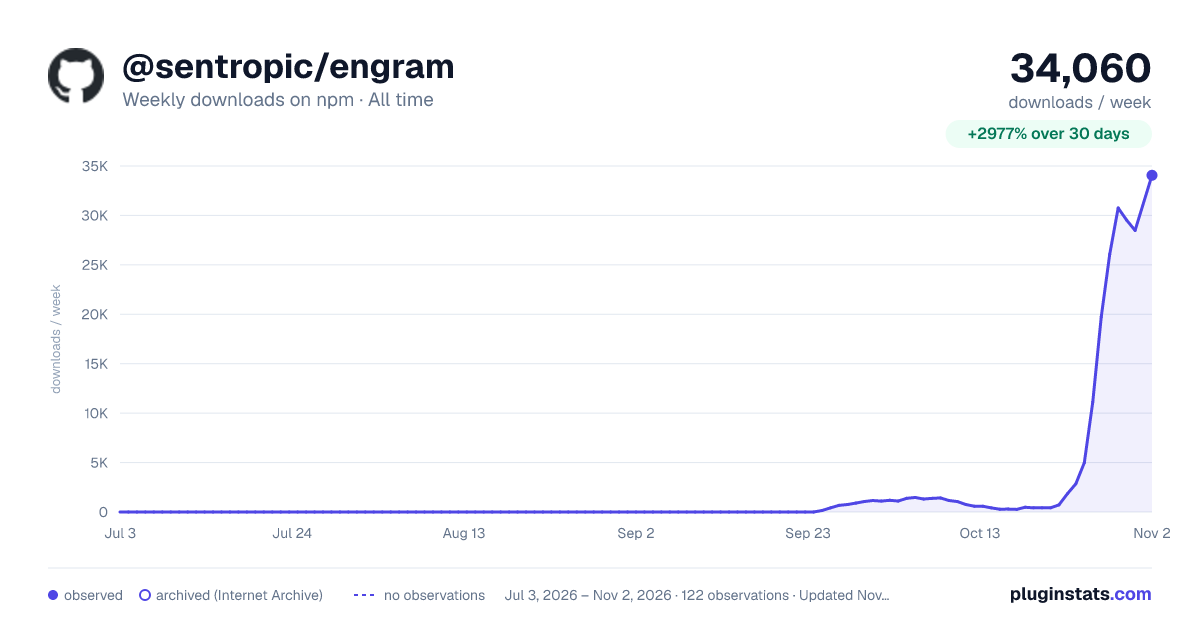

Adoption over time
7/30/90-day growth
Ranking history
Listing placement
Listing placement
Filled points are observed values; hollow points come from Internet Archive snapshots of the listing page. Dashed segments span periods with no observations — values between points are not interpolated.
Each band is one page of 20. Weekly downloads on a linear scale. Placement is projected from weekly downloads, so it can differ from the marketplace's own sort order. Hover a dot to see the listing.
Recent observations
Full history (1)Similar npm Claude Code plugins
All 20 @sentropic/engram alternativesData source
Weekly downloads (trailing 7 complete days) come from the official npm downloads API. Downloads include CI and mirrors and are not equivalent to installs or users. npm publishes no ratings.
Listing: https://www.npmjs.com/package/@sentropic/engram. First seen Oct 29, 2026; last successful collection Oct 29, 2026. See the methodology.