 PluginStats
petbox-wire weekly downloads statistics
By stdray · npm · Claude Code
Wire any project to PetBox (Claude Code, opencode, Factory Droid) — global hooks, MCP configs and skills — with a single npx command, no repo clone.
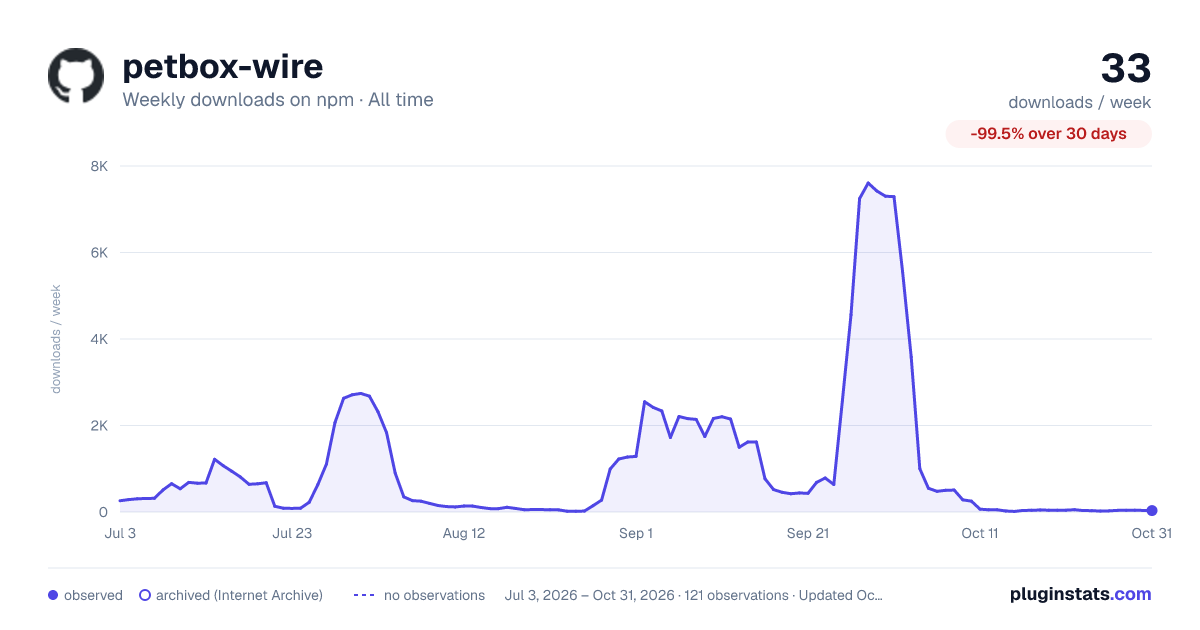
petbox-wire has 46 recorded weekly downloads on npm, ranking #1853 of 2,391 tracked listings.
About petbox-wire
petbox-wire
Wire any project to PetBox for Claude Code, opencode and Factory Droid — one command, no repo clone:
npx petbox-wire <dir> <project> --key <KEY>
Full documentation: https://petbox.3po.su/doc/wire.
Requirements
Node >= 23.6 — the kit is plain TypeScript run through Node's native type-stripping (no build, zero runtime dependencies). Older Node exits with a clear version error.
Commands
| Command | What it does |
|---|---|
petbox-wire <dir> <project> | Full wire: validate the key → persist it → copy the kit → register the directory → write per-project MCP configs and skills → install the global hooks → self-smoke. Idempotent. |
petbox-wire update | Refresh only the stable kit under ~/.petbox/wire/ (exact mirror + orphan cleanup, content hash before → after). No keys, no registry, no hook reinstall, no MCP/skills, no sticky-flag reset. Does not compile agent files. |
petbox-wire apply [--offline] | Compile the per-harness agent role files from the portable agent definition (built from files: base < user < project) + your local role→model binding. |
petbox-wire layers [dir...] | Show the definition cascade: which layers exist, what each did to the roster, and which layer supplied every field. Read-only. |
petbox-wire status [--offline] | Print fact, not a verdict: per role × harness, the materialized artifact path, its bound model and where that model came from, plus a layers/roster/canon/skills summary. Read-only, never gates; --offline skips network lookups (the definition never needed one). Always exits 0 unless status itself crashes. |
petbox-wire doctor [--offline] | Gate (exit code is significant): resolves the agent definition from the file cascade (base < user < project) and checks it against every known harness, printing OK or each violation, plus the layers and their per-field provenance. A broken layer is a hard failure here, same as in apply. Also reports skill-file drift against the kit templates, the session-banner budget margin, and a tail of ~/.petbox/wire.log. Network checks are skipped with an explicit reason when the server is unreachable; --offline skips them itself up front (skill-file drift and banner-budget checks) — the definition resolve and the truthfulness gate still run, because neither touches a network. |
petbox-wire roles | Print the active profile and its role→model bindings (~/.petbox/roles.json), each with the provider serving it and whether the kit or you set it. Offline; an empty store exits 0 — no model is ever invented. |
petbox-wire roles export | Write a bootstrap copy of roles.json to stdout (no secrets). Pipe it to a file on a new machine. |
petbox-wire profile use <name> | Set activeProfile in ~/.petbox/roles.json. Compiles nothing — re-run apply. |
petbox-wire model set <role> <model> [--agent <id>] [--profile <name>] [--allow-unknown-model] | The only sanctioned way to write a role→model binding to ~/.petbox/roles.json. Compiles nothing — prints next: petbox-wire apply. |
petbox-wire model unset <role> [--agent <id>] [--profile <name>] | Remove a role→model binding for the given agent/profile from ~/.petbox/roles.json. Compiles nothing — re-run apply afterwards. |
update, apply, status, doctor, roles, profile and model take no <dir> <project>.
Flags (full wire)
| Flag | Effect |
|---|---|
--key <KEY> | The project's API key. Mint it on the project's Connect agent page in the UI — key minting is out of scope for this tool. Omitted → taken from the env var, then from ~/.petbox/keys.json. |
--env <VAR> | Override the env-var name holding the key. |
--workspace <WS> | Workspace stamped into the generated SKILL.md. Omitted → the workspace the server reports for your key; if neither is available the wire stops with a usage error (exit 2). |
--cleanup-legacy | Remove a project's old per-project hook/plugin copies. |
--telemetry | Wire Claude Code OTLP export into the project (off by default; Claude Code only). |
--telemetry-log <name> | Target named log for telemetry (default cc-telemetry; created if missing). |
--help, -h | Usage banner, exit 0. |
The API key is validated against the server before anything is persisted, so a bad key never lands in your stores.
The env-var name
The key is held in PETBOX_<PROJECT>_API_KEY — the project key upper-cased, runs of
non-alphanumeric characters collapsed to _, leading/trailing _ trimmed, PETBOX_ prefixed
(kpvotes → PETBOX_KPVOTES_API_KEY). Same name the UI's Connect page shows you. --env overrides
it, and a re-run reuses whatever name is already recorded for that directory — so a machine wired
before this scheme keeps its older variable. ~/.petbox/keys.json is the ground truth for the name
your machine actually has.
What it installs…
Description from the npm listing.
- petbox
- wiring
- claude-code
- opencode
- factory-droid
- mcp
README badge
Show your rank in a README or on your website. The badge updates automatically.
Charts
Images: 30d · 1y · all time · 1600×900 dark



Adoption over time
7/30/90-day growth
Ranking history
Listing placement
Listing placement
Filled points are observed values; hollow points come from Internet Archive snapshots of the listing page. Dashed segments span periods with no observations — values between points are not interpolated.
Each band is one page of 20. Weekly downloads on a linear scale. Placement is projected from weekly downloads, so it can differ from the marketplace's own sort order. Hover a dot to see the listing.
Recent observations
Full history (1)Similar npm Claude Code plugins
All 20 petbox-wire alternativesData source
Weekly downloads (trailing 7 complete days) come from the official npm downloads API. Downloads include CI and mirrors and are not equivalent to installs or users. npm publishes no ratings.
Listing: https://www.npmjs.com/package/petbox-wire. First seen Oct 21, 2026; last successful collection Oct 21, 2026. See the methodology.