 PluginStats
@sagentlab/navarch-runtime weekly downloads statistics
By sagentlab · npm · Claude Code
Navarch machine-side session manager: claims delivery tasks and runs them through local coding agents.
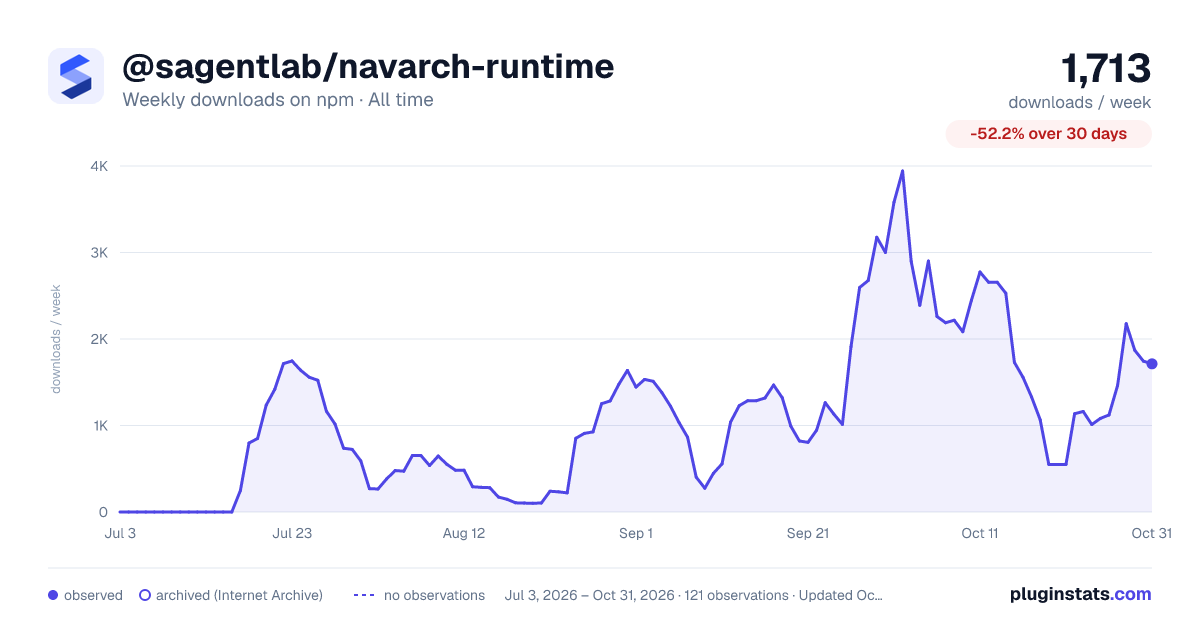
@sagentlab/navarch-runtime has 1,066 recorded weekly downloads on npm.
About @sagentlab/navarch-runtime
navarch-runtime
Conversation mirror isolation and lifecycle fixes are included in runtime 0.1.115.
Managed visual evidence
Host-mode build, verify, and QA leases requiring browser-use receive a
navarch_browser MCP server with capture_visual_evidence in Codex, Claude,
Antigravity, OpenCode, and ACP sessions. It runs Chromium in the runtime process's
environment, outside the coding agent's OS sandbox, with a fresh browser
context for desktop and touch-enabled mobile captures. It neither uses the
operator's browser profile nor executes agent-provided scripts.
The same server offers interactive local_browser_open, local_browser_click,
local_browser_fill, local_browser_press, local_browser_snapshot, and
local_browser_screenshot tools for walking through a service the agent starts
on this machine. That browser is limited to loopback (localhost,
*.localhost, 127.0.0.0/8, ::1). Every request, WebSocket, or navigation
to any other host is aborted and listed in the tool result. The agent's own
sandbox can already reach these services, so the tools add a browser without
adding network reach. Each lease gets one tab at a time, a fresh context per
viewport, and at most 300 actions.
Install the runtime's pinned browser once on the agent host (and after a Playwright version update):
npx @sagentlab/navarch-runtime browser-install
The source installer does this automatically. Linux hosts must also have
Playwright's Chromium system libraries installed. Browser-startup failures
are returned as capture errors; the runtime does not relax host permissions.
Docker sessions continue to use their image's tooling, and an operator-supplied
NAVARCH_MCP_CONFIG_PATH remains authoritative.
User-attached MCP servers
Besides the platform MCP, a session receives the HTTP and stdio MCP servers its
project or organization attached (POST /api/broker/mcp-servers; see
User-attached MCP servers). The runtime
merges them into the per-session MCP config for Claude Code, Codex, OpenCode,
ACP and Qoder; other runtimes keep only the platform MCP. A stdio server runs on
this machine (inside the Docker sandbox in Docker mode) with the session's
access. The control plane drops them for review, verify and QA sessions unless
the owner opted a server in. A lookup failure or an invalid server is logged and
skipped; the session still starts. An operator NAVARCH_MCP_CONFIG_PATH
disables them.
Browser capability probe
browser-use is advertised only after a startup launch check passes. When
start boots, the runtime launches its headless Chromium on the host. Then,
for every advertised runtime that wraps agent shells in an OS sandbox
(currently Codex, unless it runs with --dangerously-bypass-approvals-and-sandbox
or danger-full-access), it launches Chromium again through codex sandbox
with the same permission policy a session gets. If either launch fails, the
runtime claims without browser-use and reports the reason on every machine
heartbeat; the Agents page shows it. The result is cached for the process
lifetime, so restart the agent after fixing the browser to re-probe.
navarch-runtime doctor runs the same check.
Codex's macOS seatbelt denies Chromium's Mach port registration
(bootstrap_check_in ... MachPortRendezvousServer: Permission denied), and
--single-process crashes once a second page opens. When Node runs in the
sandbox and only Chromium fails, the probe still passes, with that reason. Codex
sessions then browse local services through the local_browser_* tools above,
and the session prompt tells them to. With an operator NAVARCH_MCP_CONFIG_PATH
those tools are absent, so the machine does not take browser tasks; run those
with another agent such as Claude Code, or use Docker mode. Docker mode is not
probed because its image supplies the browser. Set NAVARCH_BROWSER_PROBE=off
to trust the configured capability list without a check.
Call the tool with url, source_commit_sha, and evidence_role (before or
after). Optional wait_for_selector and settle_ms let a scene finish loading.
The URL's deployed SHA must be checked by the agent: the supplied SHA is metadata,
not platform attestation. Authenticated/interactive journeys still use their
existing browser tools; this capture tool starts with no cookies.
Each successful image is registered through lease-scoped register_artifact
and uploaded to R2. The response contains durable URLs; the agent must inspect
the images. Before session completion the runtime posts the uploaded evidence
to the matching delivery PR using its scoped GitHub credential. A publication
failure keeps verification blocked and preserves the uploaded artifact URLs.
The capture endpoint binds only to loopback, requires a per-lease bearer, and
is revoked when the lease ends. Captures are serialized and limited to ten
attempts per lease. No app-repository capture script or GitHub browser upload
is required.
Run the real Chromium smoke test with
NAVARCH_TEST_REAL_BROWSER=1 npm test -- tests/browser-evidence.test.cts from
runtime/. It renders desktop/mobile PNGs through the same HTTP MCP tool while
substituting the artifact upload destination.
The machine-side half of Navarch (WP-07): registers this machine with the
control plane, then loops claim → sandbox → agent CLI → report until you stop
it. Plain Node/TypeScript, no Next.js coupling, and no shared app-code coupling
— this directory is a self-contained package you can npx on any fresh
machine.…
Description from the npm listing.
- navarch
- ai-agent
- claude-code
- codex
- antigravity-cli
- opencode
- agent-client-protocol
- deepseek-harness
- task-runner
- muse-code
README badge
Show your rank in a README or on your website. The badge updates automatically.
Charts
Images: 30d · 1y · all time · 1600×900 dark



Adoption over time
7/30/90-day growth
Ranking history
Listing placement
Listing placement
Filled points are observed values; hollow points come from Internet Archive snapshots of the listing page. Dashed segments span periods with no observations — values between points are not interpolated.
Each band is one page of 20. Weekly downloads on a linear scale. Placement is projected from weekly downloads, so it can differ from the marketplace's own sort order. Hover a dot to see the listing.
Recent observations
Full history (1)Similar npm Claude Code plugins
All 20 @sagentlab/navarch-runtime alternativesData source
Weekly downloads (trailing 7 complete days) come from the official npm downloads API. Downloads include CI and mirrors and are not equivalent to installs or users. npm publishes no ratings.
Listing: https://www.npmjs.com/package/@sagentlab/navarch-runtime. First seen Oct 22, 2026; last successful collection Oct 22, 2026. See the methodology.