 PluginStats
ai-appsec weekly downloads statistics
By subodhkc (2 listings) · npm · MCP servers
Audit AI applications and agents for security risks before commit, PR, merge, or deployment. Deterministic findings with coverage and evidence receipts.
ai-appsec has 1,030 recorded weekly downloads on npm, ranking #1439 of 2,322 tracked listings.
About ai-appsec
AI AppSec
Evidence-backed AppSec for AI applications and agents.
Powered by HAIEC.
Audit AI code for security risks before you commit, push, merge, or deploy.
What AI AppSec Does
AI AppSec produces deterministic, reproducible static security evidence for AI-agent and AI-application source code. It uses Semgrep 1.173.0 as its execution engine with a bundled Public Core rulepack (122 detectors, 79 security checks).
Key properties:
- Static analysis only — does not execute target code
- No network required for normal scans (Semgrep setup may require network)
- No HAIEC account or API key required
- Deterministic evidence — Scan Receipts with SHA-256 digests
- Fail-closed digests — rulepack/manifest verified at runtime
- Proof-of-fix — rescan comparison with check-evaluation safety
Quick Start
# Install
npm install -g ai-appsec

# Check Semgrep status
ai-appsec doctor

# Install Semgrep engine (requires network)
ai-appsec setup

# Start MCP server (stdio transport)
ai-appsec
Or use via npx without global install:
npx ai-appsec doctor
npx ai-appsec setup
Prerelease channel:
@nexttracks upcoming prereleases (e.g.ai-appsec@next).
When to Use It
Use scan_ai_security when a developer asks to:
- "check this for security issues"
- "audit this task before I push"
- "review this change for security problems"
- "scan this AI agent" or "scan this AI app"
- "check my LLM application"
- "security review this PR"
- "is this safe to merge"
- "check this before deployment"
- "audit this code for vulnerabilities"
- "run a security scan"
- "check for security risks before commit"
scan_ai_security
The MCP tool scan_ai_security is the only tool implemented in v0.1.
It scans AI/LLM/agent application source code for security risks including:
- Unsafe AI-output execution
- Secrets exposure
- RAG/model integration risks
- Insecure AI API usage
- Control gaps
- Prompt/input-related risk signals
What scan_ai_security Does NOT Do
- Does not provide complete AI system assurance
- Does not provide runtime behavioral assurance
- Does not provide compliance certification
- Does not guarantee zero false positives
- Does not prove root causes for concern families
- Does not execute target code, install dependencies, or run package managers
- Does not perform compliance assessment (compliance requires additional HAIEC evidence)
Findings
Findings are classified by:
- Finding kind: PRESENCE, RISK_SIGNAL, CONTROL_GAP, VULNERABILITY
- Severity: CRITICAL, HIGH, MEDIUM, LOW, INFO
- Disposition: INFORMATIONAL, REVIEW, BLOCK
Security Concern Families
Security Concern Families summarize semantically compatible finding instances for decision-quality presentation. A concern family is a deterministic grouping view — it is NOT necessarily one vulnerability, one material issue, or one root cause. Underlying finding instances remain auditable.
Concern family count is not a vulnerability count. Top 20 / Top 50 are presentation limits, not evidence limits.
COMPLETE / PARTIAL / ERROR
- COMPLETE: All supported files in scope were successfully analyzed.
- PARTIAL: Some supported files could not be analyzed (e.g., parser failures). PARTIAL scans cannot prove absence of findings. Missing evidence is never interpreted as PASS.
- ERROR: The scan could not complete due to an engine error.
Coverage
AI AppSec provides explicit coverage accounting:
- DISCOVERED: all files found beneath the target
- INTENTIONALLY_EXCLUDED: files excluded by scope policy
- UNSUPPORTED: files outside supported extensions (.py, .js, .jsx, .ts, .tsx)
- TARGETED: supported files intended for analysis
- ENGINE_REPORTED_SCANNED: files Semgrep reports as scanned
- PARSE_FAILED: files with parse errors
- SUCCESSFULLY_ANALYZED: scanned minus parse failures
Scan Receipt
Every scan produces a tamper-evident Scan Receipt with SHA-256 digests for:
- Finding set
- Concern family set
- Coverage file sets
- Evaluated security checks and detectors
- Semantic receipt identity
COMPLETE scans produce reproducible receipts across processes and operating systems. PARTIAL scans preserve run-specific coverage differences.
Evidence Envelope
Each scan produces an Evidence Envelope that binds the receipt to the scan execution context, including:
- Producer identity
- Target identity (scan input digest, git commit, dirty state)
- Execution status and completeness
- Semantic receipt digest
- Envelope digest
Proof-of-fix
Rescan a target after a fix to compare receipts. The proof-of-fix comparison is safe: it verifies that a specific security check's findings were resolved without requiring the entire scan to be identical.
Offline / Local Operation
Normal scanning operates fully offline after prerequisites are installed:
- No HAIEC cloud access required
- No account or API key required
- No rule download during scanning
- No telemetry emitted (Semgrep invoked with
--metrics off)
Semgrep setup (ai-appsec setup) may require network access to install the
engine. Once installed, all scanning is local.
Semgrep Prerequisite
scan_ai_security requires Semgrep 1.173.0 (exact version match).
# Check Semgrep status
ai-appsec doctor

# Install managed Semgrep (requires network)
ai-appsec setup
Semgrep is NOT bundled with this package. It is an external engine installed separately. See THIRD_PARTY_NOTICES.md for details.
Limitations
- Only
scan_ai_securityis implemented in v0.1 - Static analysis only — no runtime behavioral evidence
- No compliance certification or assessment
- No tenant isolation checking (roadmap)
- No LLM content verification (roadmap)
- No deploy security gating (roadmap)
License
MIT License
Copyright (c) 2026 HAIEC
See LICENSE for the full license text.
Security Reporting
If you believe you have found a security vulnerability:…
Description from the npm listing.
- ai-security
- ai-appsec
- application-security
- ai-application-security
- ai-agent-security
- agent-security
- ai-code-security
- ai-security-scanner
- security-audit
- security-scan
- security-scanner
- security-review
- code-security
- sast
- llm-security
- mcp
- mcp-security
- devsecops
- pre-commit-security
- pre-push-security
README badge
Show your rank in a README or on your website. The badge updates automatically.
Charts
Images: 30d · 1y · all time · 1600×900 dark


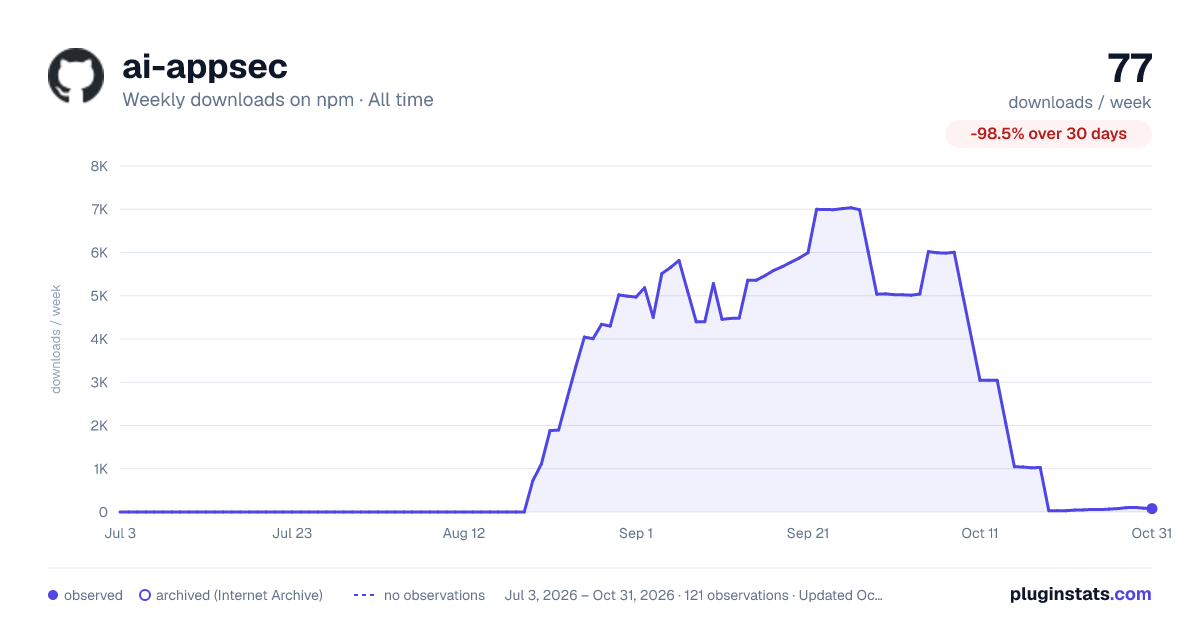

Adoption over time
7/30/90-day growth
Ranking history
Listing placement
Listing placement
Filled points are observed values; hollow points come from Internet Archive snapshots of the listing page. Dashed segments span periods with no observations — values between points are not interpolated.
Each band is one page of 20. Weekly downloads on a linear scale. Placement is projected from weekly downloads, so it can differ from the marketplace's own sort order. Hover a dot to see the listing.
Recent observations
Full history (1)Similar npm MCP servers plugins
All 20 ai-appsec alternativesData source
Weekly downloads (trailing 7 complete days) come from the official npm downloads API. Downloads include CI and mirrors and are not equivalent to installs or users. npm publishes no ratings.
Listing: https://www.npmjs.com/package/ai-appsec. First seen Oct 20, 2026; last successful collection Oct 20, 2026. See the methodology.