 PluginStats
minio/direct-csi pulls statistics
By minio (20 listings) · Docker Hub
Container Storage Interface (CSI) driver for direct attached storage
minio/direct-csi has 965,182 recorded pulls on Docker Hub, ranking #261 of 1,265 tracked listings.
About minio/direct-csi
DirectCSI



DirectCSI is a CSI driver that provisions volumes for workloads that require direct access to the storage medium. A storage medium is accessed directly when there are no layers of indirection between the application accessing storage and the storage medium. Direct access is crucial for applications that are:
- I/O intensive or
- IOPS intensive or
- Manage reliability of data at the application layer or
- Require high consistency guarantees or
- Any combination of the above
High performance applications that are tolerant to drive failures, and/or have the capability to heal data are ideal applications for DirectCSI. Examples of such applications are:
- MinIO
- Cassandra DB
QuickStart
Here is the extremely quickstart:
kubectl krew install direct-csi
kubectl direct-csi install --crd
kubectl direct-csi drives ls
# choose all the drives that direct-csi should manage and format them
kubectl direct-csi format --drives $DRIVE_SELECTOR_GLOB --nodes $NODE_SELECTOR_GLOB
# 'direct-csi-min-io' can now be specified as the storageclass in PodSpec.VolumeClaimTemplates
For more information, please visit our documentation.
How is it different from LocalVolume provisioner?
LocalVolume provisioner also allows direct access to the storage medium. However, it requires manual management of drives and volumes - i.e. it does not support dynamic provisioning of volumes, storage management or dynamic scheduling of pods on nodes with available volumes.
DirectCSI on the other hand, supports dynamic provisioning of volumes, performs allocation of volumes based on storage capacity, and schedules pods to run on nodes which have most capacity available.
How is it different from HostPath volume?
HostPath volume also allows direct access to the storage medium. However, it only supports ephermeral volumes. i.e. pod scheduling is not tied to volume provisioning. Therefore, if a pod is rescheduled or restarted, it might end up on a node where the data is not available. However, since HostPath volumes are ephemeral, pod startup will go on without raising any errors.
HostPath volumes cannot be provisioned and managed via PVC resources. It is always provisioned either manually as a PV or directly specified in the PodSpec.
Limitations of DirectCSI
The high consistency and performance benefits of DirectCSI come with the limitation that once provisioned, volumes cannot be moved to other nodes i.e. volumes are sticky to nodes. In case a node is lost, then the volume is also lost.
References
<!-- - [Usage Guide](./docs/usage-guide.md) --> <!-- - [Troubleshooting](./docs/troubleshooting.md) -->LICENSE
Use of direct-csi driver is governed by the GNU AGPLv3 license that can be found in the LICENSE file.
Security
Important: Report security issues to security@min.io. Please do not report security issues here.
Description from the Docker Hub listing.
README badge
Show your rank in a README or on your website. The badge updates automatically.
Charts
Images: 30d · 1y · all time · 1600×900 dark


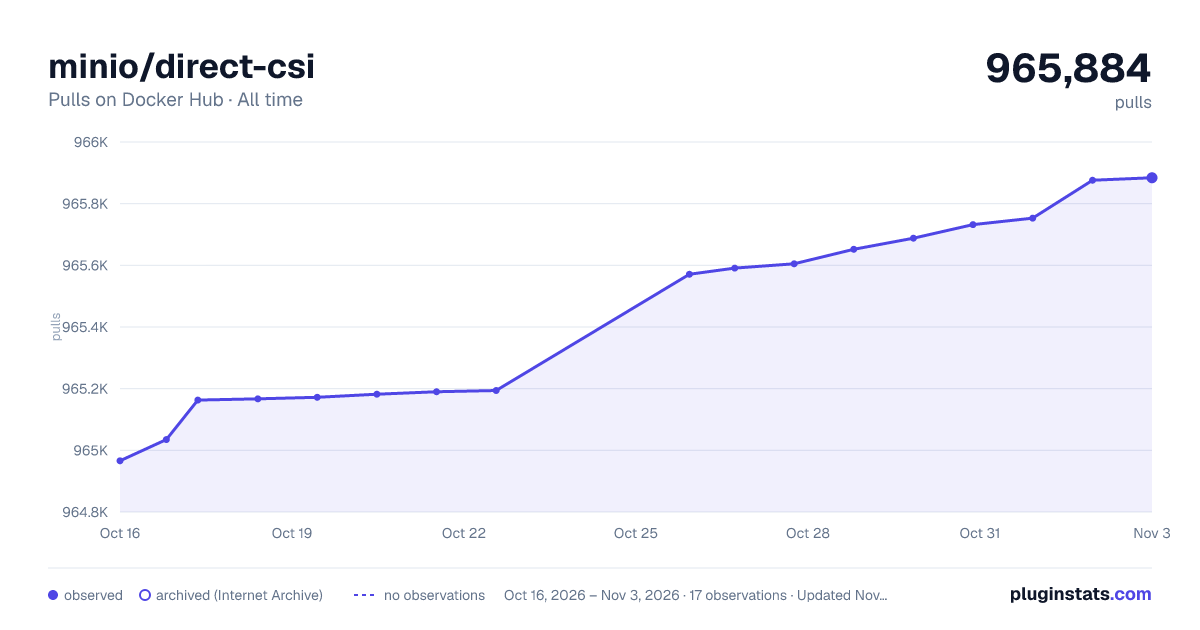

Adoption over time
7/30/90-day growth
Ranking history
Listing placement
Filled points are observed values; hollow points come from Internet Archive snapshots of the listing page. Dashed segments span periods with no observations — values between points are not interpolated.
Each band is one page of 20. Pulls on a linear scale. Placement is projected from pulls, so it can differ from the marketplace's own sort order. Hover a dot to see the listing.
Recent observations
Full history (6)Similar Docker Hub plugins
All 20 minio/direct-csi alternativesData source
Cumulative pull counts and stars come from the public Docker Hub API. Pulls count image downloads (including automated CI pulls), not installs or users.
Listing: https://hub.docker.com/r/minio/direct-csi. First seen Oct 16, 2026; last successful collection Oct 21, 2026. See the methodology.